|
|

|
| January 2026
|
|

|
|
Rupee Depreciation
Over the long term, the rupee’s average depreciation against the
US dollar has been about 3% per year. With domestic inflation
averaging around 4%, a gradual annual depreciation of roughly 3%
helps maintain India’s external competitiveness by offsetting
the inflation differential vis-à-vis trading partners.
Without this adjustment, Indian goods would become progressively
more expensive in global markets, hurting exports and widening
the current account deficit. A modest depreciation also supports
domestic growth by encouraging import substitution without
destabilising inflation. Hence, policymakers generally tolerate
gradual rupee depreciation to balance growth, inflation, and
external stability rather than defend a rigid exchange rate.
However, this year the rupee has depreciated sharply by about 6%
against the dollar. Although the dollar index has declined by
nearly 10% this year, the rupee has underperformed even against
this backdrop. As a result, the rupee’s performance against the
British pound and the euro has been even weaker.
|
|

|
|
Reasons For Weakness In The Rupee
Capital outflows and weak foreign investment
|
|
A major driver has been capital outflows from India. Foreign
Portfolio Investors (FPIs) have been withdrawing funds from
Indian equity and debt markets, increasing demand for dollars.
This is largely due to slowing corporate earnings and
uncertainty surrounding the US trade deal. Foreign Institutional
Investors (FIIs) have sold a record ₹1.6 lakh crore this year.
Foreign Direct Investment (FDI) began 2025 strongly,
particularly in Global Capability Centres, but even these
inflows have turned negative in the past couple of months.
|

|
|
Widening trade deficit and rising import demand
|
|
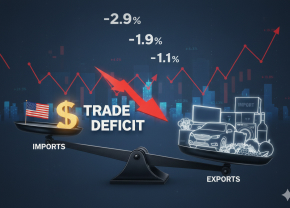
India is a large importer of crude oil, electronics, gold, and
other commodities. When imports exceed exports, demand for
dollars rises,putting pressure on the rupee. Recent data
indicates that large trade deficits are contributing to this
downward pressure. Nearly 85% of India’s oil is imported, and
imports of gold and silver have surged significantly.
|
|
Global economic and external environment
|
|
High global demand for dollars has weakened many emerging-market
currencies, including the rupee. International investors
continue to
prefer dollar assets over emerging-
market currencies.
|

|
|
Uncertainty around trade deals, especially with the US
|

|
Delays and uncertainty in trade negotiations - particularly with
the
US - have dented investor confidence. This has reduced foreign
inflows and increased risk perceptions, further pressuring the
rupee.
|
Policy stance and market sentiment;
soft central-bank intervention
|
|
The Reserve Bank of India (RBI) appears to be following a
“soft-touch” intervention approach and has not aggressively
defended the rupee. Some analysts believe the depreciation has
been partially allowed to conserve foreign-exchange reserves and
improve export competitiveness, especially in the context of US
tariffs.
|

|
|
Structural vulnerabilities in the external balance
|
|
Persistent trade deficits, dependence on imported energy and
commodities, and volatile capital flows make the rupee
vulnerable to global sentiment shifts and external shocks.
|
|
Inadequate hedging by importers and ECB borrowers
|
|
Many importers and External Commercial Borrowers (ECBs) were
insufficiently hedged. The rupee’s rapid fall led to a rush to
hedge dollar exposure, further intensifying pressure on the
currency.
|

|
|
WHY DOES THIS HAPPEN EVEN WHEN GDP GROWTH IS HIGH?
At first glance, the weakness of the rupee appears
contradictory. India recorded 8.2% GDP
growth last quarter—the
fastest in the world—driven by strong manufacturing, services,
and domestic demand.
However, GDP growth reflects domestic economic activity, while
the rupee is largely influenced by external
factors such as
trade balances and capital flows. Rapid growth often widens the
current account deficit as imports rise, increasing demand for
dollars. At the same time, a strong US dollar and higher global
interest rates can divert foreign capital away from emerging
markets, even when growth is robust.
The RBI focuses on managing volatility rather than targeting a
strong rupee, as a mildly weaker currency supports export
competitiveness. Exchange rates often follow global flows and
external dynamics, not just domestic fundamentals. Strong growth
does not always translate into a strong currency.
|
EFFECTS OF RUPEE DEPRECIATION
-
As a net importer, India faces higher costs for
crude oil, electronics, gold, fertilisers, and other
imports, potentially widening the current account
deficit.
-
The S&P
Import-dependent companies face higher input costs,
squeezing margins or passing inflation on to
consumers.
-
Servicing
foreign-currency debt becomes more expensive,
affecting corporate profitability and government
fiscal metrics.
-
Bond
Foreign travel and overseas education become
costlier, requiring higher savings. Conversely,
travel to India becomes cheaper and more attractive
for foreigners.
-
Indian
exports become more competitive in global markets,
benefiting certain sectors.
-
Tourism
inflows are likely to increase due to a weaker
rupee.
|
STEPS TAKEN TO STABILISE THE RUPEE OVER THE MEDIUM TERM
1. Major FDI reforms
-
Insurance:
FDI limit raised to 100% from 74%.
-
Defence manufacturing:
FDI cap increased to 74% under the automatic
route.
-
Telecom: 100% FDI
permitted under the automatic route to support 5G and
digital infrastructure.
-
Space sector:
Liberalised rules allow up to 100% FDI in satellite and
component manufacturing.
-
Manufacturing:
Most sub-sectors allow 100% FDI, supported by PLI
schemes.
-
Renewable energy:
100% FDI permitted under the automatic route.
-
Healthcare and
pharmaceuticals:
Strong inflows, with up to 100% FDI allowed in
greenfield pharma projects.
|
|
2. Landmark financial-sector investments
|

|
Japan’s Mitsubishi UFJ Financial Group (MUFG) has agreed to
acquire a 20% stake in Shriram
Finance Ltd for approximately
$4.4 billion, the largest
FDI in India’s financial services
sector. Other notable deals include investments involving
Emirates NBD, RBL Bank, Yes Bank, Federal Bank, Manappuram
Finance, and IDFC First Bank.
|
|
3. Trade developments and export resilience
|
|
Despite the absence of a US-India trade deal, India’s
merchandise exports to the US rose 22.6% year-on-year in
November, narrowing the current account deficit
sharply. India
is also transitioning toward proactive trade liberalisation
through FTAs and CEPAs, with agreements signed with the UK and
Oman and negotiations ongoing with the EU and others.
|

|
|
4. Rupee-rouble trade settlement with Russia
|

|
Around 90–95% of India-Russia
trade is now settled in national currencies, reducing
dollar dependence. Russian banks and companies are investing
surplus rupee balances into Indian markets and government
securities.
|
|
5. Improving corporate earnings outlook
|
|
Corporate earnings appear to be bottoming out after a period of
pressure. Improving tax collections, easing input costs, and
better operating leverage are early signs of recovery, which
could attract foreign investors back into Indian markets.
|

|
|
6. Inflation management and nominal GDP growth
|

|
While real GDP growth was strong, nominal GDP growth remained
modest due to low inflation. The government is comfortable
importing some inflation via a weaker rupee to achieve
double-digit nominal GDP
growth, which is critical for fiscal
targets, infrastructure spending, and employment generation.
|
|
7. Strong remittance inflows
|
|
India remains the world’s largest recipient of remittances. In
FY 2024–25, inflows reached a record $135.46 billion, helping
offset trade deficits and providing stable foreign-exchange
support. A weaker rupee increases the domestic value of
remittances.
|

|

|
The government is actively promoting high-spend, longer-stay
tourism segments such as medical tourism,
MICE, eco-tourism, adventure tourism, and cruise tourism.
Tourism contributed
6.6% of GDP in 2024 and is targeted to reach
10% of GDP.
|
|
CONCLUSION
Some experts believe the rupee may not weaken much further. With
supportive government measures and a potentially weaker dollar,
the rupee could strengthen over the next four to five years.
Some analysts even project levels of ₹60–65 per dollar in the
long term.
|
|
|
MARKET OUTLOOK
|

|
Equity
Market
|
In
Equity markets remain range-bound with no clear direction.
December-quarter corporate results will be closely watched as
earnings are expected to improve gradually. Lump-sum investments
can continue in hybrid funds, while equity exposure may be built
through Systematic Investment Plans (SIPs).
|

|
Debt
Market
|
While
In December 2025, the Indian debt market remained stable. Short-
and medium-duration bonds performed better amid easing
inflation, adequate liquidity, and expectations that the RBI is
nearing the end of its tightening cycle.
|

|
Precious Metals
|
In December 2025, silver surged sharply due to strong industrial
demand, tight supply, and a weaker rupee. Gold rose more
moderately, supported by central-bank buying and geopolitical
risks. Given silver’s parabolic rise, partial profit-booking may
be prudent.
|
|
|